Look at Obama's top donors and the people--other than blacks--that supported him most: the white educated class. This is especially true of the Jewish population, the most successful in America which voted 80% for Obama. Jews are not only overwhelmingly liberal but have great influence in media, and they used their power to make Obama president. So, Obama-ism didn't happen because the unwashed masses smashed down the gates of the rich. Rather, Obama-ism is socialism perpetrated by some of the most successful and most educated people in America. Sure, Obama got the bulk of the black vote, Hispanic vote, and some blue collar white vote--as Democratic candidates tend to do. What's striking is he pulled ahead because he got much of the upper-middle class white vote--and Asian vote(another successful group in America).
So, why would rich and successful people support Obama? (1) Fear. The rich and successful are anxioius about the rising tide of envy and resentment among Middle Americans. So, what is to be done? Buy off a radical like Obama and make it seem as though America is now controlled by someone who 'cares for the people'. If a black man is president, there really must be Change upon the land. Rich people have tried to buy off radicals before. Neither Mussolini nor Hitler could have succeeded without the support of the rich; the Italian and German bourgeoisie sensed that people were growing more restless, and therefore, it would be a safer bet to have a 'man of the people' take power--at least nominally--and dole out handouts to calm the unwashed massesive. Hitler, you recall, calmed the people down with public works and jobs. Of course, Hitler also outmanuevered the rich people and brought destruction to Europe. But, Obama is firmly in the hands of the rich who've bought and marketed him. (2) Intellectual arrogance. The educated class sat through many lectures in colleges and read many books written by leftists. Education is a good thing, but intellectuals have a tendency to mistake book learning with actual reality. At any rate, they hold ideals at odds with reality and believe that they must have more power through government to push their ideals or ideology onto all the people. (3) Sheer powerlust. There are many kinds of power but political power is most addictive and potent. Rich people aren't satisfied with economic well-being or power; they want political power,and bigger government means more power in their hands; sure, they have to pay higher taxes, but as they--or their children--will be running government(Kennedies, Bushies, etc), they don't mind. (4) Conscience. Rich white people have swallowed the religion of political correctness and multiculturalism. But, almost all of them know nothing of poor people. They live in highrise condos or in gated communities away from the 'disenfranchised'. By making Obama president and expanding government--which will be run by people of their social status--in the name of helping 'the people', white liberals can feel 'progressive' and 'inclusive'.
We have to start accepting the reality that GOP is no longer the party of the rich and successful. GOP is the party of Joe the Plumbers. Democratic Party, for all its pandering to labor and minorities, is also the party of urban, privileged, highly educated, and very wealthy upper- and upper-middle class. It will become more so since rich people send their kids to elite colleges, and guess who runs those institutions? Also, kids raised in privilege want 'clean' jobs or to follow 'noble' callings in life, and nothing is said to be nobler in our democratic society than 'serving the people'. To serve the people, you need political power. See how clever it is. Liberals serve themselves by claiming to serve the people. Of course, one could argue that a successful businessman creates jobs and opportunities and so on, but he's said to work for 'profit' whereas politicians and bureaucrats are said to work for the 'good of the people'--with taxes taken from successful businesses of course. Anyway, the point is socialism is a worse habit among the rich and successful than among the poor. The poor didn't come up with the ideology of socialism; rich educated people did. It's rich people who've been using socialism to gain power for themselves in the name of the people. And, many people fall for it because it sounds nice and very Christian--help the poor, take care of needy, 'greed' is evil, etc.
Obama-ism is not about the masses tearing down the rich. It's about the rich buying off a radical to push their own agenda. Though Obama acts like a proud black man, he's really just a puppet-boy of the white liberal upper-class. You might call this pre-emptive socialism. Old-style class warfare would be where the masses rise up and tear down the system. In pre-emptive socialism, the rich people buy off mass envy and resentment by propping up a symbolic radical like Obama who will then do as the rich white liberals tell and guide him. Obama knows nothing about economics, so he will fetch when Larry Summers and Tim Geithner tell him to. And, bigger government isn't necessarily anti-capitalist as far as the liberal rich are concerned. More government spending means more contracts for favored private companies. Just as Halliburton found the Iraq War to be quite lucrative, many liberal leaning private companies are bound to make 'obscene profits' from the Obama order.
Thursday, January 15, 2009

Tuesday, January 6, 2009
Sean Penn's "INTO THE WILD" and what it tells us about culture and the Left.
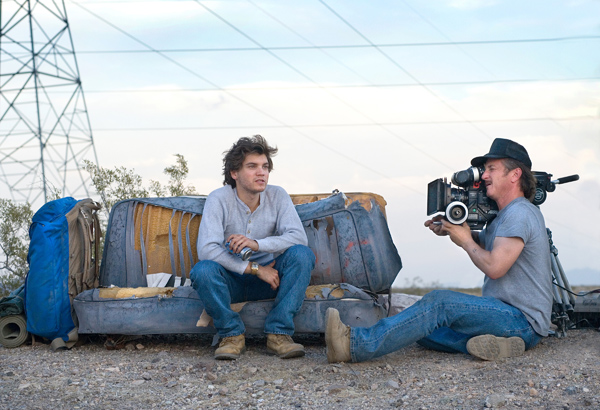
"Into the Wild" is one of the better films of recent years, but it’s not without considerable problems. Sean Penn is an able director and has an eye for nice details but lacks a sure-footed personal vision or style characteristic of the great ‘auteurs’. To be sure, personal style can get in the way or overwhelm a particular subject or theme–impose the director’s narcissistic will–, and it is true that some films have more to gain by less directorialism. Still, Penn was shooting for personal filmmaking with "Into the Wild". It’s not your average flat-footed and earnest road movie/story of self-discovery. Penn has employed the vast array of cinematic language to tell a story of this guy who ventured into the wilderness to find his true inner soul. The problem is these techniques generally don’t amount to much beyond art-film eye candy; as such, it may be higher quality eye-candy than most but eye-candy nevertheless. There are breathtaking moments in "Into the Wild", but they are momentary. We don’t sense a sustained directorial vision that pulls it altogether. In some ways, "Into the Wild" is comparable to "Dances with Wolves" and "Passion of the Christ", also films made by actors-turned-directors. Perhaps, actors have a different approach to directing. Most directors approach cinema as something watched and choreographed whereas an actor-turned-director may bring his acting mindset to filmmaking. An actor is always the center of attention, he is watched than doing the watching. This may explain why the eye-candy emphasis in the films made by all these men.
Nevertheless, "Into the Wild" is a pretty good film and some of the images and the story left an impression on me. The story is compelling enough, there are harrowing moments, and the road movie aspect is enjoyable. Most of all, Penn should be lauded for having approached this story from a psycho-biographical than from a socio-political angle. The temptation would have been great in many a liberal or leftist director to turn this story into an inspirational tale of an idealistic young man searching for justice, truth, beauty, and purity in a world corrupted and compromised by greed, deceit, compromise, and whatnot. Though Penn’s sympathies are with the rebellious–and left-leaning–hero, "Into the Wild" is–wittingly or unwittingly–a penetrating analysis and exposure of the left-libertarian rebel mentality(or any radical departure from the norm). We see the desperation alongside the heroism. We see the self-deception within the search for ‘truth’.
It’s often been said that the personal is political, but it’s also true that political is personal. The emotions that fuel the youthful hero’s quest or escape in the movie are largely familial and personal. By temperament, he’s a contrarian who wants to do everything differently. And, his family life, though economically stable, has been lacking in the kind of warmth and trust essential to happiness. Like most young people, he’s full of energy and not quite capable of understanding his own soul. Intelligent and aggressive, he looks and searches outward. Since he’s lived in the world of men all his life, he figures all moral and social discontents are associated with civilization. The only way to find truth is to take leave and reconnect with nature. Or, at the very least, one must always be on the move, not attached anchored to anything or anyone. In this sense, this is a much more truthful film than "Motorcycle Diaries" which would have us believe that Che Guevara’s enraged passions were all about social injustice and American imperialism than his own ugly hangups and megalomania.
In "Into the Wild"–again, whether Penn meant it or not–we can’t help but see the megalomania at the core of Bill McCandless–the hero. He obviously wants attention, recognition, and adulation as a special kid, a wonderful kid, a brilliant kid, a courageous kid, etc, etc. Problem is he’s not really That Special. Sure, he’s smarter than most kids but no Einstein(in an Ivy League setting, his smarts would be dime-a-dozen). He likes to do the odd or wild thing, like running to the stage to receive his diploma. Been there, done that. Maybe in the 50s or early 60s, that might have attracted attention, but in the age of "Girls Gone Wild", that’s Mr. Rogers crap. He’s read a good deal of books and romanticizes about some ideal life apart from civilization, but the 60s generation has done that already. Indeed, he meets a hippie couple who ride around in a trailer and grow old on the road. Again, been there, done that. Also, in this age of the internet where every kid–smart, dumb, pretty, ugly, American, foreign, etc–is a celebrity with his own blog and myspace site, Bill’s egomania is dime-a-dozen. There is no escape, not even in escape, because it’s all been done and told about and read about before in a million books and magazine articles. Bill, at least from what I’ve been able to gather from the film, has a personality much like Mao Zedong, Adolf Hitler, and Che Guevara. He’s a poet-rebel-tyrant, the sort who’s not even satisfied with power but must keep pushing the envelope.
Some tyrants are satisfied with power and control. Stalin, though murderous, wasn’t much of a gambler. But, Hitler wasn’t satisfied with being Fuhrer of Germany. He wasn’t even satisfied with having won control over much of Western and Central Europe. He dreamt of building a mega-city called Germania and had to gamble everything to defeat the Soviet Union and turn all the eastern territories into parts of the German empire. Mao wasn’t satisfied with power either. As a poet-intellectual, he tended to see everything in a kind of mythical and mystical way. So, he embarked on the Great Leap Forward, as though men could achieve godly deeds if imbued with the proper zeal. After that failed, Mao called on the most cataclysmic revolutionary excess in history, the Cultural Revolution, which was suppose to cleanse the revolution of impurities and re-energize it for a future generations. And, Che wasn’t satisfied with the victory in Cuba. He felt restless and hit the road, traveling to Africa to foment revolution there; the utter failure of that venture only whetted his appetite for more, and he went into the jungles of Bolivia to ignite communist revolution that he hoped would spread all the way to Canada. All these men spoke of history, the people, justice, and so on, but they were driven by their own megalomania, self-importance, passion for power, etc. They tended to have a romantic, mythic, and artistic view of history and humanity than the ‘compromised’, ‘normal’, ‘square’, or ‘bourgeois’ kind. Such people are found in all areas of life, perhaps most in the artistic community where it’s no sin–indeed a necessity–to be wildly imaginative, different, contrarian, rebellious, etc. As art is fiction and fantasy, who cares if the rules and ideas are crazy? Wagner’s madness was no problem as long as it was restricted to the operatic stage. Of course, Wagnerianism was a problem on the historical stage, and this is where art can be dangerous. Art or the system of idol-making does inform the way we see and feel reality, and it has a way of becoming entangled or interwoven with ideas and politics. In time, ideology may become inseparable from Idology. Indeed, a great many people gain their ideology through idology. The songs, the rituals, paintings, and architecture of the Catholic Church have been as important–if not more so–as the Biblical Text in converting non-believers or in making good Catholics out of children. Most communists never read much of Marx. They were won over by catchy slogans, songs like the International, the pageantry and shameless kitsch, leftist artistry, the cult/image of rebellion. And, this is also true of democracies. Many–perhaps the majority–people vote based on the appeals of symbolism, imagery, presentations, and performances. It was not political or intellectual sobriety that led to victories of George W. Bush or Barack Obama. If democracies are generally preferable to autocracies, it’s because no single person or group can grab all the power–though it must be said that US has pretty come under control of the liberal/leftist Jewish elite which gained almost total domination of the media, arts, and academia, the institutions that shape our imagination, ideas, and sense of reality.
Anyway, I got the impression that Penn wasn’t stupid enough to swallow whole the idealistic aspects of the story. Perhaps, he was attracted to this story because it made him face his own demons. As we all know, Penn is a moral narcissist, radical maverick, and a self-centered prick(not necessarily bad for art). Penn must have seen himself in the story of Bill–the good and bad sides. Perhaps, Penn made it partly as a celebration of the wandering free spirit and as a cautionary tale of being wrapped up tightly within oneself. Indeed, that is the irony of Bill’s story. He travels and sees more than most people, but he is trapped in the same place–within himself. On the one hand, he feels morally and intellectually superior and wants to match it with physical superiority; but, his need to prove himself to himself and to people around him betrays a sneaking self-loathing and self-doubt. He roams about freely, but in some ways, he’s a one-man totalitarian state, a kind of hermit kingdom of the soul that seeks utter isolation and independence. Of course, he never is–as his needs are always met by contact with humanity, and indeed when he’s finally alone and isolated in Alaska, he pitifully meets his doom. Also, personal memories keep creeping through the cracks of his iron-walled psyche. The fact that he keeps moving or running is proof that he is running FROM something; as long as he keeps running, he will never be free from that something.
Penn can’t help being a narcissistic-leftist-bullying-clown. People like him are actually as contrarian as they’re radical. They always wanna stick out in the crowd. So, Penn is pro-gay-agenda in the US but will also hang out with the Castros and Hugo Chavez–very anti-gay latin machomen. How is this possible? Because of Penn’s contrarianism. The way he sees it, US is run by evil heterosexual white males, and so Marxism and gay-agenda are both suitably anti-American. There is no real rational system to Penn’s thought process; it’s really a knee-jerk emotional response.
Penn may also have been drawn to this story because of his compromised position as a Hollywood star. Penn sees himself as a true artist, a great actor, and even a greater potential director. Yet, he’s made a good number of box-office hits and have enjoyed Star treatment. He knows he’s talked the talk but hasn’t always walked the walk. Also, even genuine artists are fakers in the sense that they are dealing with artifice. They are pretenders, not doers. Marlon Brando figured this out and disdained acting in his later years. He could play the best this or that, but he was only acting; he was a performer before the camera, not an actor on the world stage. He felt phony, and I suspect Penn shares some of this doubt. As such, Penn celebrated a guy who didn’t just talk the talk but walked the walk of totally ‘free’ behavior. Bill really did what he set out to do–stupid or wise.
Warren Beatty may have felt the same way when he made "Reds". John Reed, whether you like him or not, threw himself into the Bolshevik Revolution. He helped Lenin, Trotsky, and Stalin become the leaders of Russia. He wasn’t just a writer or just a journalist but a crusader who devoted his life to a cause. Foolish or not, he wasn’t just an observer or imitator of history but a doer, an actor on the world stage.
Wanting to actively practice one’s ideals or throw oneself into historymaking has long been the theme of many creative and intellectual people on both the right and left. Mishima staged the ridiculous coup and slit his own belly because he felt insufficient as a mere intellectual and writer. Pasolini and Godard both grew increasingly radical and political, feeling compromised as mere ‘bourgeois’ artists; they came to use their cameras like AK-47s or Khmer Rouge-ish machetes. Writers like Garry Wills have condemned John Wayne for having been all talk but no walk, all bark but no bite–Wayne, the hero of many war films, did not ever serve in WWII.
Some artists want to live up to their popularized ideals while others shy away and work to counter the public image of themselves. In American cinema, perhaps Clint Eastwood has gone furthest in the latter regard. Having become world famous for his roles in the nihilistic Spaghetti Westerns and bloody Dirty Harry films, Eastwood-as-director has tried to play down the image of the invincible killer or enforcer with the infallible gun. Some artists need to be more-than-human; Eastwood has been stressing the need to be more-human. Eastwood as director has been telling us that he’s not a star but a rock–albeit a special rock–on the ground. While many directors go for Greatness, Eastwood’s style is unassuming and without Pantheonic gestures. Orson Welles wanted to be the god of cinema–and he had the talent to prove himself. Eastwood wants to be an honest filmmaker.
"Into the Wild" lies somewhere in between Wellesianisms and Eastwoodisms. Stylistically, it’s quite ambitious. Penn is pretty adept–if not brilliant–at composition, editing, and. But, the movie is also down-to-earth and realism-istic at other times. The story shoots for the stars, reality hits the ground over and over.
Perhaps, Penn made this film partly to tell his critics that he knows all about the dangers and foolishness of unfettered radical or maverick mentality. Many people see Penn as a self-absorbed nut, and Penn could be saying, ‘look, if I made a substantially critical film about someone I admire and identify with, doesn’t it tell you that I’m aware of the pitfalls of megalomania?’ Nice try, Penny, but we know you’re a nutter just the same. No one can escape oneself. Not Bill, not Penn, not you nor me. We is what we is.
There is a number of films that came to mind while watching "Into the Wild": "Vagabond" by Agnes Varda, "Jeremiah Johnson" with Robert Redford, "Easy Rider", "Picnic", and most of all, "Here’s Your Life" by the great Jan Troell. There were also aspects of the films of Terrence Malick, especially in the voice-over narration, but that may be the weakest part of the film. For Malick, it worked for "Badlands" and to a lesser extent with "Days of Heaven", mainly because the simple musings against the backdrop of the big world suggested a troubled irony. But, it was disastrous in "Thin Red Line" where we were supposed to regard the voice-over narration as profound philosophical ruminations. In "Badlands" and "Days of Heaven", the narration emphasize the mystery of the world beyond human understanding. In "Thin Red Line", the pompous narration cheapens and reduces what we see; we think... ‘oh, so THAT’s what all of this is about’.
In "Into the Wild", the narration consists of ernest thoughts and observations by Bill’s sister, and they are painful to the ear. They are inane, precious, mushy, gooey, and etc. And, we are supposed to take them straight. "Into the Wild" is not without irony, but irony flies out the window whenever we hear the trite poetic waxing of Bill’s sister. (Maybe, he was trying to get away from her). Her observations don’t really tell us something we couldn’t glean from the story as it unfolds. Also, her words have a way of, at once, sanctifying, spiritualizing, and Dr. Philosophizing Bill to death. Oh, if he’d just ended up on Oprah instead of Alaska, it would have ended up oh so nicely for everyone!
It must be tough sometimes to be both a tough guy and a progressive. Penn sees himself as both and shares the insecurities of fellow leftwing Jewish artists like Oliver Stone and the late Paul Newman. Penn wants to be seen as a tough and rough guy but also a caring sensitive guy. The story of Bill captures both aspects of leftism. On the one hand, there is Bill who is upset with the hypocrisy of mankind and wants to be a ‘good guy’. On the other hand, there’s Bill the rugged man of the wild; and he’s no vegetarian and hunts for food. He’s like Che Guevara of self-reliant survival; indeed, his Alaskan venture ends rather like Che’s Bolivian venture. Both Che and Bill are restless types who must always seek new excitement and new challenges. They want to push the envelope. Thankfully, Bill only wanted to push himself whereas Che wanted to push all of humanity toward his vision of justice. Another figure Bill has similarities with is Ted Kaczynski the Unabomber. Kaczynski was somewhere between Bill and Che. On the one hand, he did want to radically change society; on the other hand, he was hermetic and wanted to be on his own. To his credit, Bill never means no violence to anyone. Also, he hunts only for food. But, I wonder if he realized to what extent he relied on the people and society he held in such low regard. After all, books, guns, clothes, and even most of the food he’s eats were all man-made and mass-produced by modern society. Indeed, people like him could putz around through great distances because there are man-made roads stretching all across this vast continent and because surplus of goods allows a good many people to be generous.
Bill is strange in having both greater empathy and contempt for most people. Unlike most people who stick to family and friends, Bill wanders and gets to know all sorts of people. But, he will not commit to anyone because his personal religion is himself and his own sense of freedom and destiny. He feels that everyone is like a turtle without the balls or guts to do what he’s chosen to do.
Finally, he comes to a bad end, and this is where the movie turns into great art. Bill’s final days are presented with power and poetry. It has the ring of truth without dramatic overload or stylistic excess. It’s painful to watch, and even skeptics must feel obliged to respect a part of Bill’s being which accepted his fate with whatever grace and inner-peace he could muster up. In one way, he dies as the petulant kid wishing to lay a guilt-trip on his parents and feeling superior to rest of compromised mankind. But, in another way, such things no longer matter; weakened, weary, dying of starvation, poisoning(from eating mis-identified plants), and the cold, he comes to sense something bigger than his ego, convictions, and conceits. Up until then, he’d traveled all around United States; finally, it’s as though some higher spirit is traveling through him, carrying his soul to a peaceful place.
"Into the Wild" also keys us as to why leftists make better artists than conservatives–at least in the modern world. However crazy leftists may be, there is a sense of adventure, empathy with others, curiosity, and open range spiritualism. It’s true enough that good many talented leftists are egomaniacs, but they feel a need to understand and connect with the larger world or with the deeper areas of their souls. There’s also a Promethean sense of going where and doing what no one has done before. Much of this may simply be a self-delusional conceit, but delusions may lead to creativity and new ideas.
Oliver Stone and Sean Penn both have this spirit.
In contrast, take conservative entertainers like the Frasier guy and Drew Carey, and you got little more than comfortable notions about good vs bad and social niceties. To be sure, Mel Gibson of "Apocalypto" and John Milius of "Apocalypse Now" have been powerful–if not necessarily great–artists, but notice both have essentially wandering pagan souls(despite Gibson’s Catholicism). Radical leftism may be stupid, but many leftists haven’t been afraid to go to the ends of the world–or at least pretend to--to see and do something different. Of course, leftism is ultimately foolish because its stated goal is a totalitarian society run by radical intellectuals where individuals no longer have any freedom. Of course, anarcho- and libertarian-leftists will claim they are for a progressive and pluralistic order of free individuals, but anarchism and libertarianism are social impossibilities.
Still, leftists–as long as they don’t have total power–have a certain spirit that fuels their creativity. It’s also crucial to creativity that leftists tend to be irreligious or anti-religious. As such, they see themselves as gods. Though this may be immoral and sacrilegious to conservative or religious folks, it’s good for art. All great artists see themselves as gods of sorts. Beethoven couldn’t have composed what he did if he had the personality of your average conservative. Okay, what about Bach and Handel? I would argue that in their art, they didn’t just accept God but searched for God, explored the richness and depth of the spiritual realm. For them, God was as playful and humorous as great and awesome. Today, most conservatives worship God-as-dogma, the Gun-as-baby-bottle, or Greed-as-religion-unto-itself. There’s nothing wrong with God and Guns as long as they are spiritual or political crutches. As for Greed, that’s what money becomes if one sees and judges everything in terms of dollars and cents. This is all the funnier when liberals and leftists generally beat out conservatives in the Game of Greed. Your average Naomi-Klein-reading leftist yuppie is likely to be richer and more materialistic than some Ayn-Rand-reading conservative clod.
"Into the Wild" is not a perfect movie, and Penn is not one of the greatest directors ‘of all time’, but Penn and his movie show us in spades that leftists have the adventurous spirit necessary for personal art. "Reds" by Beatty may be a stupid movie politically, but we can admire the romanticism of Beatty–and that of John Reed. They believed in the drama of history, the epic poetry of the adventurous ego. Bad for politics but good for art. Show me a creative conservative spirit who feels a mad passion to make a great film about Teddy Roosevelt or Ronald Reagan. None. Instead, most conservatives are Dilbertarian pundits who politically talk the talk but don’t culturally walk the walk. Art and creativity requires a degree of madness. There is plenty of madness on the right but the energy is directed toward religious moralism than toward paganesque creativity. The Right needs to go into-the-wild to discover its own fire of creativity.
Wednesday, December 24, 2008
CLOVERFIELD and DIARY OF THE DEAD as (Post)Apocalyptic Film-making.


There was a bunch of apocalyptic movies in the 90s exploiting the vibes surrounding the approaching millennium. As it happened, the latter part of the 90s was relatively stable. The late 80s and early 90s saw the fall of Iron Curtain and communism relegated to the dustbin of history. There were economic good times under Clinton, who was a ‘new kind of Democrat’. There was the rise of Tony Blair in UK too. It was as though the right vs. left dichotomy was a thing of the past. Clinton was a free market globalist liberal who could work with conservatives in congress. With the rise of internet stocks, it seemed as though most Americans would become prosperous. As the 90s progressed, many believed the US was ‘building a bridge to the 21st century.’ Clinton was even called the ‘first black president’, as though race no longer mattered. We could almost forget about the Gulf War, the LA riots, and the Oklahoma bombing. Crime rates were falling. NY, once considered irreversibly in decline, was again a safe place to live. Of course, there was the threat of terrorism, but Americans shrugged off the first attack on the twin towers in the 90s. The fact that the towers had stood the test and the culprits apprehended and brought to justice made most Americans feel safe and invincible. There were some major bombings overseas–most notably in Africa–, but the world wasn’t much alarmed as, well, the third world was the third world–as usual. As long as we could occasionally lob missiles at nations like Afghanistan or Sudan, we thought we were safe. More troubling for us was the disintegration of the deal between Israelis and Palestinians. Perhaps, that was a portent of things to come.
Anyway, most of us were in a celebrating mood as the new year/decade/century/millennium dawned. So, all those Hollywood films about the End of Days or Armageddon were made and watched in jest; it was more like an apocalyptic chic than anxiety about what might REALLY happen. (Similarly, radical chic has always been for the privileged secure in their belief that the revolution would never touch their lives.) We felt so secure and strong that even the idea of the sky-falling-down was part of the cool celebration; we hyped it as though to mock it. So, we had movies about satan’s evil plans, an asteroid about to tear Earth a new arsehole, or some other concoction about everything blowing up reeeeaaaaaal good. They were nothing more than cinematic fireworks, pure popcorn movies. 2000 came around, people celebrated around the world, and all seemed well. To be sure, the stock market tumbled, but most Americans felt it was a momentary lull to pull back from the excesses of the 90s, the hip-hop age. So, we ended up with a ‘humble’ president in the man of George W. Bush. We looked to a period of stability, sobriety, and slow-down before things would start booming again.
But, then 9/11 happened. The feeling of invincibility went out the window. The stock market fell even more. But, Americans, being Americans, rallied and supported the lightening war against Afghanistan and achieved quick victory. It was as though America would own the 21st century. The attacks on 9/11 gave US the moral capital to use its force around the world.
But, then came Iraq. Bush wanted to be a man for the ages. He gambled and lost–at least in the short term. He couldn’t have given a better present to anti-Americans, leftists, and Islamic radicals. Even his supporters grew embarrassed of their commander-in-chief and then, even of the military, and began to harbor doubts about American power around the world. Oddly enough, genuine apocalyptic fears reached critical mass only after 2003. The Iraq war was the catalyst–not only because of the long-drawn-out war and political complications in Iraq, but because of the moral revulsion created by Abu Gharib, Guantanamo, and the issue of torture–, but there were other factors too.
Being out of power politically, leftists and liberals–who control the media, academia, and entertainment–grew angry and unhinged and produced books, music, and movies whose purpose was to make Americans and the world feel disgusted at America-under-Bush as much as possible–politically, diplomatically, militarily, culturally, morally, environmentally, etc.
The Katrina disaster was everything rolled into one–fears about global warming, unpreparedness of our government, racial tensions, ineffectiveness of Bush, national disconnect among regions, the divisions between ‘haves and have-nots’, etc. Liberals and leftists had a field day making, turning it into a secular version of ‘god punished us for our sins’. It was their Noah’s Ark story... from which we needed a Messiah(and guess who?).
In the 90s, with Clinton at the helm, Hollywood gave us stuff like "The American President" and "The Contender". With Bush as president and Congress dominated by the GOP, leftists and liberals in the media were determined to make as many Americans hate their own country as much as possible. The main reason why young people have turned overwhelmingly liberal in the last several years is because they depend on popular culture and celebrity news for information on much of anything. For most young people, the Bourne Trilogy, Matrix movies, V for Vendetta, articles in Rolling Stone ragazine, statements by Rock stars, TV talk shows, MTV, and etc. are the source of their worldview. Initially, due to 9/11, leftists and liberals were restrained in their anti-Americanism, but Bush’s Iraq misadventure gave them an opening. As the war dragged on and disgusted even many American conservatives who felt duped by Bush and his ‘neo-con cabal’, the leftist and liberal attacks on Bush’s America grew stronger and gained momentum. Even superstar conservative film makers gave us a pretty bleak vision of the world. Mel Gibson’s "Passion of the Christ" was blistering and bleak, not a movie to feel good about. His next film, "Apocalypto" was about the corruption and fall of a civilization intoxicated with hubris and arrogance. And, his drunken meltdown did severe damage to his career in a Jew-dominated industry. Clint Eastwood made two excellent films–Flags of Our Fathers and Letters From Iwo Jima–, but they weren’t rah-rah movies by any means. They were defeated at the box-office, and conservatives had little to rally around–not their president, no cultural figures, no nothing... except some blustering talk radio hosts becoming more irrelevant by the day as they’d thrown their lot with Dubya.
For many people, it really seemed like US was helplessly on the ropes. That the so-called mightiest nation was hopelessly mired in a poor and desperate country made many people lose confidence. And, Bush increasingly seemed like an idiot or buffoon, incapable of even stringing together simple sentences. He had talked tough like a Texan cowboy before the war on Iraq, but as the war dragged on, he sounded more like a retarded dummy on someone’s lap.
Just when US seemed to be in big trouble, we heard more news about the rise of China. Trade deficits were going through the roof. And, national borders were utterly broken. If patriotic conservatives were unable to do anything about the Invasion by foreign illegals–a problem plaguing Europe as well–, was there a future for the Western world?
There was a true cloud of apocalyptic fears gathering in our culture and politics. If the pre-2000 apocalyptic films were in jest, films since the Iraq War took on genuinely dark overtones and conveyed the real possibility of an apocalyptic or post-apocalyptic landscape.
It was this sense of malaise which laid the ground for Obama’s rise. Though a cheap, dirty, thuggish, and self-promoting Chicago machine politician–and black nationalist and stealth Marxist radical–, he had the fortune of being handpicked by the super-rich and super-powerful liberal and leftwing Jews who run the national media, culture, and academia to run as the New Hope of mankind. Of course, many sappy white gentiles loved him too, especially the privileged ones whose socio-historical consciousness was formed in schools taught by liberals and by PBS documentaries and Hollywood films that give us the impression that blacks are inherently nobler than the insipid, bland, and generic honkeys.
If white girls voted for Obama out of political jungle fever, white boys voted for him because they’d been castrated into metro-sexual faggoty-ass dweebdom.
But, there was a political, spiritual, and cultural climate for this kind of CHANGE. There was a sense that Clinton had ultimately failed us in the 90s. US grew richer but the boom did end in bust, and Clinton was no moral exemplar. So, Hillary couldn’t convince people that she represented something new. As for Bush’s compassionate conservatism, it turned out to be socialism-with-tax-cuts-for-the-rich; as for his cautious and humble foreign policy, oh well. As for McCain, he looked old and mummified. He didn’t have the look and spirit of something new. So, there was Obama. By going with Obama, Americans could pretend to be back in the year 2000, starting the millennium anew. It’s as though we’d made a mistake in 2000 by going with Bush–not that Gore would have been any better. They were both insipid white males. Of course, many Americans are wary of black politicians and black folks, but Obama looked and sounded special. He had some of that black soulfulness without coming across as aggressive and intimidating; he mastered the art of Oprah’s pompous fatass bullshittery which melts the hearts–and minds–of stupid white dupes who dream of a Great Black Hope who’s worthy of admiration and respect and not out to intimidate or beat up. He seemed intense without really being angry. He seemed smart without being intellectual. To be sure, he’s a pompous, self-centered, narcissistic, and insufferable jiveass motherfuc*ing jerk, but in this Age of the Celebrity, that sort of thing sells.
Anyway, Obama is the fantasy voodoo doll that will supposedly erase our memory of the past 8 yrs, or even 16 or 20 yrs. It will be the end of apocalyptic fears, and the start of something new–or so Americans(and fools around the world)think. With the economic catastrophe–largely caused by liberal Jewish finance capitalistss who supported Obama and have much to gain from Obama’s administration–, people want some kind of relief, new sign of hope.
So, what is the nature or mood of our apocalyptic anxieties? Consider a film like "Children of Men". Though far from a great film, it frighteningly depicted a plausible scenario of total social breakdown. It really presents a vision of hell and effectively exploits all our fears–low birthrates among whites, illegal invasion, terrorism, state power, militarism, mob rule, etc. Also, it’s documentary style makes us feel trapped and claustrophobic. Events seem unpredictable and real than staged and choreographed. In its cluttered and chaotic universe, Hollywood suspense is an unaffordable luxury. Things happen or they don’t. You get shot or you don’t–but you’re bound to be hit sooner or later. "Children of Men" is ultimately a sensationalistic, trashy, and shallow, but it’s impossible to shake off its harrowing effects. Some people have compared "Children of Men" with "Blade Runner", but the comparison is fundamentally flawed because the world of "Blade Runner", though dark, is fascinating and awe-inspiring( and cool) rather than revolting or repulsive. I can imagine fans of Blade Runner wanting to visit the world of Tyrell corporation and the replicants, but who’d want to spend a single minute in the world of Alfonso Cuaron’s film? So, at the very least, Cuaron succeeded in creating a genuinely unnerving apocalyptic landscape.
So, what is the nature or mood of our apocalyptic anxieties? Consider a film like "Children of Men". Though far from a great film, it frighteningly depicted a plausible scenario of total social breakdown. It really presents a vision of hell and effectively exploits all our fears–low birthrates among whites, illegal invasion, terrorism, state power, militarism, mob rule, etc. Also, it’s documentary style makes us feel trapped and claustrophobic. Events seem unpredictable and real than staged and choreographed. In its cluttered and chaotic universe, Hollywood suspense is an unaffordable luxury. Things happen or they don’t. You get shot or you don’t–but you’re bound to be hit sooner or later. "Children of Men" is ultimately a sensationalistic, trashy, and shallow, but it’s impossible to shake off its harrowing effects. Some people have compared "Children of Men" with "Blade Runner", but the comparison is fundamentally flawed because the world of "Blade Runner", though dark, is fascinating and awe-inspiring( and cool) rather than revolting or repulsive. I can imagine fans of Blade Runner wanting to visit the world of Tyrell corporation and the replicants, but who’d want to spend a single minute in the world of Alfonso Cuaron’s film? So, at the very least, Cuaron succeeded in creating a genuinely unnerving apocalyptic landscape.
Two other films of comparable style and effect are "Cloverfield" and "Diary of the Dead". Neither is great by any stretch of the imagination but both are effective in the way of "Children of Men". They both convey horror and despair beyond the scope of crowd-pleasing spectacles.
Cloverfield is post-9/11(and the Iraq War) as "Independence Day" and "Pearl Harbor"–and the End of Days films of the 90s–are pre-9/11. When NY and the White House were blown up in "Independence Day", the audience cheered–not out of anti-Americanism but out of incredulity. And, audiences who flocked to see "Pearl Harbor" felt safely distanced from the actual event and marveled at it as movie theme park. Movies like Titanic and Pearl Harbor, though apocalyptic in tone, tended to be hopeful, romantic, and grandiose. Okay, so US was attacked by the ‘Japs’ and thousands died. Never mind the grisly details and just get your kicks out of all those special effects; besides, we know US won WWII anyway. As for Titanic, the jaw-dropping special effects overwhelmed the fact that people were getting killed in the disaster; besides, Celine Dion’s song and the love story made it all so meaningful and sweeping. Also, it too is set in the past, and we know the world survived WWI, WWII, and the Cold War since the Titanic disaster; as such, it was an exercise in nostalgia as well as a celebration of the latest movie techno-gizmo in cinema.
Films such as these were specifically made to be crowd-pleasers. When buildings blow up in "Independence Day", we are not expected to visualize or think of actual people dying inside them. We were meant to look upon them as ‘cool effects’.
But, I doubt if anyone was laughing or cheering when NY is struck by calamity in "Cloverfield". When we see a building fall in the distance, it reminds us of what happened on 9/11. And, the home video style keeps us close to and on the vulnerable level of the characters; we have no superiority-of-safety over them–other than the fact that we are not actually there.
The weakest part of the movie is the monster itself, awesome though it is. Somehow the realism of the home video is undercut by the existence of something so far-out and grotesque.(It’s as though a Noah Baumbach film got invaded by Godzilla). But, the style carries the movie through, especially since the focus of the film is about survival and cooperation than monsters wreaking havoc. We remain close to the characters, almost as if we are being-john-malkoviched through each of them.
In a movie like "Independence Day" or the far superior "War of the Worlds"(Spielberg), the spectacular style diminishes the human dimensions. We become impressed with the pop-wagnerian spectacle and, as a result, happy to sacrifice our sympathy with ant-like humans. This was the moral argument against Star Wars and LOR film from certain quarters. Not that Lucas or Jackson personally endorses the destruction of millions, but the vastness of their narrative canvas reduces the destruction of entire worlds into mere afterthoughts. We don’t have such luxury in "Cloverfield" and "Diary of the Dead". We cannot marvel at the awesomeness of something blowing up or crashing down in "Cloverfield" without it affecting our characters–rather badly. There is no safe vantage point to which we can cut in and out of.
When 9/11 happened, many people said it looked like a movie–where violence looks real but no one gets hurt. Secure in our knowledge that no one actually dies, it’s easy to be seduced by the nihilism of movie violence; the style takes precedence over the moral substance of a violent act(after all, it’s all fake, right?) We’d long felt a disassociation between the imagery of destruction and its physical outcome. Being mostly familiar with movie disasters, we’ve come to regard calamities as something created in a magic factory. But, people were confronted with the fact that on 9/11, real people were getting burned, falling out of buildings, getting buried under the rubble, etc. 9/11 forced many Americans to rethink violence, tragedies, and even heroism. We’d all grown accustomed to movie heroes of superhuman power always coming out on top. Oliver Stone’s film WTC showed us that even the toughest and bravest Americans–firemen, policemen, etc–are only human, and that true heroism is quiet and resilient. (Sadly, it was a flop, and again, we have movies like "Dark Knight" making gazillions from morons hooked on Hollywood fantasies–and plunking down their hard-earned cash only to make Liberal Jews who run that empire richer and richer). Perhaps, people in other nations who’ve experienced greater calamities first hand have a different view of reality and history–on the other hand, the popularity of mindless Hollywood movies all over the world indicates that all peoples have short memories and trouble with the truth. (Most disturbing of all is the flippant and nihilistic treatment of nuclear disasters and earthquakes in Japanese anime.)
The core conceit of "Cloverfield" negates the luxury of perceptual detachment in favor of spectacle over characters. We are forced to accept that it is a home video of people navigating through a frightening urban landscape; it’s kinda like "Metropolitan" crossed with "The Warriors"(or perhaps "Open City")–with a bit of "Saving Private Ryan" thrown in for good measure.
As such, everything we see is fixed at the human level. There can be no montage to a non- or supra-human angle for the purposes of aestheticism or a ‘cool’ view.
Of course, the whole thing was conceived and executed for effect, mainly for a fresher kind of chills and thrills for young moviegoers bored with most conventions. No one’s looking for anything natural or truthful in "Cloverfield". It could even be argued it is less honest than your average Hollywood movie which comes with no pretensions except to entertain and rake in the money.
Still, the ground rules set by "Cloverfield" makes greater interest than on average.
For starters, the visuals, always attuned to the characters’ will to survive and help one another, don’t carry the implicit baggage of nihilism contained in the third person perspective; there are no ‘interruptions’ of unfolding events with fancy editing, slow-motion, and other tricks which accentuate style over content. Because our access to reality is only through our characters, we share their vulnerability every step of the way. It is this sense of being trapped in time and space with an handful of characters that increases the level of apocalyptic anxiety. There is a sense of a calamity too big for the human senses and mind to process. We feel like human insects–quite different than looking down on people as insects; looking down on people-as-ants, we smugly share god’s perspective.
In reality, a cut in space or time from one perspective to another is simply not possible; everyone is trapped in his own reality. Most movies are constructed of many perspectives, both subjective and ‘objective’. As such, the viewer almost gains the perceptive power of a god or, at least, an angel.
To be sure, access to multiple perspectives can make the viewer feel even more helpless and terrified as in the famous scene in "Alien", which cuts back and forth between a group of people tracking the whereabouts of the monster and a man unawares in a tunnel. But, the conventional movie with third person perspective can always cut to a safe haven no matter what; it is based on the notion of the invincible, or at least, the innumerable camera. In "Cloverfield", there is only one camera, which underlines the fact that everyone has only one life. As with "Blair Witch Project", there is and can be no reality outside or beyond the camera. The camera in "Blair Witch Project" or "Cloverfield" is mortal and vulnerable. It breathes, runs, lives, and dies along with its handler.
If Blair Witch Project was a cheapie indie film, "Cloverfield", despite its ‘simple’ conceit, is surely an expensive film. It is all the more remarkable for this fact for it has seamlessly interwoven the expensively outlandish with the ‘cheaply’ realistic. Because of the dogged consistency of its style–and the dedication and talent of its actors–, genuine anxiety and horror are maintained throughout. Some may condemn it as a case of Hollywood appropriating indie techniques for no other purpose than to make a buck, but it isn’t the first nor will it be the last.
Something about "Cloverfield" both annoyed and inspired me. Its cast of characters are in their late teens or early 20s. They are the children of yuppies of the late 80s and early 90s. They are privilege born of privilege; they register as zeroes. They are realistic enough, which is the very problem; our society has a lot of well-educated and overly privileged drones. They talk a lot but have nothing to say. They are post-everything. Post-conservative, post-liberal, post-ideological, post-post-modern, etc, etc. We know that many kids of yuppies go to fancy schools, learn from privileged radical professors, and even put on radical airs themselves, but they are, foremost, children of privilege satiated and bored with privilege–and even bored with being bored with privilege.. The kids in "Cloverfield" are the shallowest and most rootless bunch of people; they’re too hip to be snobby but they’re also too hip to be hip. They are ‘nice’ and ‘tolerant’ and into ‘diversity’. They’re mildly ‘correct’ in a privileged world where certain disaffected attitudes are the price of admission. They are also the most self-absorbed bunch of insipid fools I’d ever seen. The guys are mostly like clones of Ethan Hawke, who mastered this type of post-everything personality on film. The girls are mostly insipid twits who chit-chat airhead crap.
The first 1/4 of the film takes place at a yuppie-junior party, and it’s convincing enough as social document. Indeed, had the monster never materialized, the entire film might have made a decent enough flick about the lives of today’s privileged youths–an annoying but truthful enough film.
But, when the monster comes and terrorizes the city, the kids are forced to muster their courage and stamina, and the transformation is convincing enough to win some of our respect. It goes to show that inside every dork and twit, there is something nobler than the habit of checking the cell phone every 10 minutes. (Nobility, like monstrosity, lies dormant within us, and depressingly, only tragedy can awaken and bring it to life. We have to look at the devil in the eye to realize the angel within us.)
As the city crumbles all around them, they are forced to put aside their boutique-zen disaffectedness and awaken as feeling/thinking adults.
When the film began, the kids acted like they were too cool even to be cool, too beat even to be beat, etc--as though they were beyond both passion and dispassion. They didn’t even have the hippie’s dedication to being laid-back or the snob’s delight in greater wealth or higher status. The core of their privilege is being oh-so-nonchalant about their privileged status. The 60s youth had idealism, even if stupid. The 70s were about enjoying the new freedoms and lifestyles won in the 60s. The 80s were thrilled with lower taxes, booming economy, and the new patriotism. Everything began to get tiresome in the 90s. Hip-hop was lively but mindless and polarizing. Grunge and other forms of rock music were world-weary deadends. Clinton’s consensus style of politics was satisfactory but not satisfying. The nation was at peace and good times were at hand, but there was no longer any central theme. The theme of the 60s was liberation and rebellion. The theme of the 70s was finishing what began in the 60s and/or working toward a national renewal. The theme of the 80s was saving the economy and defeating the Evil Empire. The 90s were a good decade but a theme-less decade. Sure, Clinton reduced crime by throwing many more negroes in jail than any previous president and enacted welfare reform, but those things failed to engage the ‘spiritual’ passions of the people. As for Bush, no one could really take him seriously, and his comparison of himself with Churchill and Truman seemed funny as hell.
And now, even as the world faces great new challenges, many of our privileged lived in the Francis-Fukuyama-ist -End of History–not the apocalyptic kind but the anti-climactic triumphal kind where liberal democracy is supposed to have won the battle of history and ideas. So, there is utter dispassion among the privileged kids we see in "Cloverfield". Even though or precisely because the world is more connected than ever, today’s urban young are cocooned in their cool fanciful world with all sorts of gadgets and goodies. Even as the working class and lower-middle class Americans have faced stagnant wages, the urban professional class has seen tremendous rise in their wealth and privileges. "Cloverfield" is about the children of the professional liberal yuppie class. These are the people who voted for Obama because he fit their ideal of the privileged-mandarin-celebrity-narcissistic-yuppie-professional-who’s-supposed-to-be-post-everything. It’s post-radical chic.
They have this ‘been there, done that attitude’. And, this sensibility is partly, I believe, the product of our increasingly connected and electronic age. With cell phones, global internet access, a zillion images and sounds downloadable from all over the world, with endless sources of news, there is a sense that everything has been seen, heard, shared, experienced, and felt. Nothing is fresh or exciting to these kids hooked via their ipods to the global village all day and night. Every corner of the world has been explored and mapped out; Google Earth allows any dork or twit to fly all around the world. With advances in psychology and tell-all/share-all talk shows, there is also a sense that we’ve heard of every hang-up, every break-up, every possible social or emotional neurosis. And, having avoided a truly grave economic downturn for so many decades, there’s a sense that everything will turn out alright in the end. Also, with the rise of shamelessness–Jerry Springer, declaring bankruptcy, mainstreaming of porn, etc,–there’s nothing to culturally shock us anymore. And, with things like myspace and what have you, everyone has his 15 gigabytes of celebrity. Even celebrity culture has become a parody in the age of Paris Hilton and Anna Nicole Smith–and when just about anyone can effectively ape those idiots via youtube or the internet. But, even parody has become tiresome and lame.
And, in a world where kids of all background get along–at least within certain socio-economic circles–, there is little urgency about social progress. So, that’s the kind of reality we see in the first part of "Cloverfield". A bunch of nice kids who are annoying as hell because they are not committed to anything. Not that it’s their fault; it’s just the nature of the age they’ve grown up in.
Anyway, the kids are shaken out of their doldrums by this monster that wreaks havoc on NY. The monster is less important that what it forces out of the characters–reach deep within to find unknown reservoirs of strength. Of course, the whole movie can be seen as just another exercise in youth narcissism. As if being privileged weren’t enough, young people today have to be flattered as closet-heroes who would stand up to any challenge! So, the film begins with a bunch of comfortably privileged and numb kids, but we come to see them act with toughness, resilience, determination, and camaraderie.
When the monster first attacks, it reminds us of 9/11. But, the prolonged assault on the city and the mounting difficulties remind us of the Iraq War. And, as the kids huddle under a collapsing bridge in the final scene, they might as well be Iraqi civilians hiding from US bombing. Perhaps, the film is saying that US was struck by monstrousness on 9/11, but we then morphed into a monster of our own making. In our anger, we unleashed ‘shock and awe’ assault on Iraq; we too released a monster on another city.
Anyway, for all its conceit and bogus nature, "Cloverfield" is a gripping film. And, its amateur home video style restrained the visual and audio gratuitousness so routine across the blockbuster movie landscape. Big movies are saturation-bombed with an excess of visual trickery and auditory madness. Every sound roars like thunder or rumbles like an avalanche. A pin drop sounds like an hammer hitting the anvill. A whistle sounds like a supersonic jet. And, digitally tweaked slo-mo, the fancy acrobatic editing, CGI trickery, ludicrous action choreography, and so on, while technically dazzling and impressive, are more often than not mind-numbing sensory overloads. "Cloverfield" is pretty mindless as material but interesting as execution. It has the immediacy of real events and is reasonably compelling as a human story. Of course, if this becomes the new staple in Hollywood, it’ll be just as dreary as what we generally have now.
Inherently, there’s nothing wrong with any filmic approach. Personally, I think Peter Jackson’s "King Kong" is magnificent for what it is. But, who can deny that most movies use technology to serve a formula than a vision? If I’m not mistaken, "Cloverfield" was, at the very least, made by someone with fresh ideas. And, it’s not disgraceful.
For some viewers, George Romero’s "Diary of the Dead" may be the most interesting film. Romero has a reputation as an intellectual in some circles, and critics have regarded his zombie films as satire on one thing or the other. Personally, I think Romero has made one great film–"Night of the Living Dead"–, one highly interesting film–"Martin"–, and then mostly garbage. "Diary of the Dead" is a return to form of sorts though Romero is treading much the same ground. Like Stallone with Rocky and Lucas with Star Wars, Romero seems incapable of box office success outside his original formula.
Many horror flick fans will, of course, defend "Dawn of the Dead" as a great movie, and it has a special place in my memory–I first saw it as an highly impressionable kid. But, I’ve revisited that film, and every re-viewing has diminished its worth. With zombies pretty much ruling the world, the story has nowhere to go. "Dawn" is somewhat interesting as a survival game of logistics and strategy, but it’s essentially "Night" expanded into a franchise; fittingly, it’s set in a shopping mall . As for "Day of the Dead" and "Land of the Dead", they were not even fun as trash. .
There are obvious problems with the zombie scenario. Just how can zombies take over the world when they are slow-moving and easy to spot? What with Americans owning 100s of millions of guns, you’d think every zombie would be shot within seconds of coming into view. This is why "Night of the Living Dead" is plausible within the logic of zombie universe. Zombies may take over an isolated community. But, they are bound to lose to lots of men with guns, and that’s how the movie fitfully ends. But, we are asked to suspend more than disbelief when zombies quickly take over the world in Dawn. With "Day" and "Land", it seems 99.9% of the planet is ruled by zombies. How?
It is for this reason that Romero has finally done it right with "Diary of the Dead". No, it was not worth doing, but if had to be done again, this was the ONLY way. To be sure, zombies seem to gradually gain the advantage, but the shock and uncertainty make for ‘spiritual’ malaise as well as physical horror. A movie where zombies rule over everything just isn’t interesting–just like a bodysnatcher movie with everyone as a pod person. The problem with Dawn, Dead, and Land is the zombies have won already; with only a few humans left, all that’s possible is internal bickering or a shooting gallery of horrors. (Of course, one could argue that Romero’s larger point is humans defeat themselves than are defeated by the zombies. If people all unite and work together, zombies ought to be no problem. But, humans fall prey to greed, desperation, cowardice, egocentrism, pride, envy, etc, and as such are incapable of working together. So, it’s not so much zombies beating humans so much as humans freaking out and defeating themselves, whereupon zombies take over from humans’ self-destruction. Recall that in "Dawn", humans fought humans in the mall, and in the end, the zombies unwittingly took the whole prize. Perhaps, one could drawn an analogy with the Roman Empire where the more advanced Romans couldn’t hold back the Germanic tide because of internal divisions. And, perhaps the same could be said of Europe and US today. Though richer and more powerful than the rest of the world, the internal divisions–liberal vs conservative, men vs women, atheist vs religious, etc–make it nearly impossible for the people of either Europe or US to come together to confront the threats of illegal immigration, cultural rot(such as zombie movies), and the like. Of course, Romero is politically on the left, but one can understand why his movies are so popular with right-wing nuts.)
In ‘Night of the Living Dead" and "Diary of the Dead", the process of the world becoming zombified is a novelty worthy of shock, horror, debate, and anxiety. In "Day of the Dead", in contrast, there is only the prospect of physical horror. In "Night of the Living Dead" and "Diary of the Dead", we ask the question, ‘why is this happening?’ By "Dawn" and "Day" came around, ‘it’ had happened already, and there wasn’t anything else to do but shoot zombies by the bushel.
Still, zombie films shouldn’t raise too many questions, and "Diary" suffers as a result. I said young people in "Cloverfield" talk a lot but have almost nothing to say. It’s worse in "Diary" where every word is nonsensical, ludicrous, precious, moronic, pretentious, pregnant, and annoying. The worst offender is the leading female character who’s supposed to be the model of ‘the strong intelligent female.’ Ideals are always less interesting than Reals. Then, there is the film professor, an Englishman, who seems have an inkling--philosophical, spiritual, intellectual, social, and political–as to why the dead are walking again but cannot be bothered to share his wisdom; he talks in riddles as though he can’t be bothered with anything resembling simple truth. The girl is supposed to represent feminist/American toughness and individualism, the professor is supposed to embody old world experience, patience, and irony. They put on superior airs all throughout the movie, like they know or sense something others–and we–don’t. And, Romero sympathizes with them most. But, I wonder... what is the value of their supposed intellect or insight when confronted with something monstrously raw and savage? The only option is to survive, and ideas seem trivial. (Of course, Romero fans can argue that the professor and the feminist girl have superior qualities. The girl is both tough and adaptable, intelligent and intuitive. And, the professor is smart enough to understand that a lot of things are unknowable, and therefore, one’s intellect should try to find ways around things than try to access their inner truth–which is like opening pandora’s box. The professor’s attitude seems to be that people, being what they are, will always open pandora’s boxes everywhere–political, scientific, social, economic, religious, etc–, and dire problems will ALWAYS plague our world. So, the thing to do is to keep one’s cool, maintain’s one’s sanity amidst insanity--by accepting insanity as the natural order among humans--, not be surprised or shocked by anything, and try to find the best way possible to maintain one’s small oasis of safety and peace.)
Romero always put on pompous airs. So, he had a one-legged black guy in the beginning of ‘Dawn of the Dead’ say, ‘when the dead walk, we must stop the killing’. What does that mean within the context of zombies coming back to life to eat people?
Preachy spiritual or philosophical meaning is impossible in such context. If a tiger wants to eat you and your friends, what sense does it make for you guys to debate the meaning of life or the cosmic injustices of the world? Just get away. This is why "Night of the Living Dead" made moral sense. The characters don’t debate about some larger meaning; they register shock and horror at what’s happening and then get down to the messy art of survival.
But, already by "Dawn of the Dead", Romero was acting all pompous, as if his gore fest was onto some deeper meaning. So, he had the black guy say stuff like, "my grandfather told me... when there’s no more room in hell, the dead will walk the earth." Oh really? Actually, Romero’s bullshit began even with "Night of the Living Dead". The lone surviving black guy is ACCIDENTALLY shot dead by white townsmen, yet the grim final still images invoke the Jewish holocaust and lynching. But, the killing was accidental. The white gunman thought the black dude was a zombie. Romero unconvincingly tried to add a layer of social meaning to his movie, as though "Night" had something to teach us about racial oppression, genocide, and perhaps Vietnam. This was utterly unnecessary.
All the commentary about the nature of man was there in the story itself. The irony of "Night" is that zombies, though ravenous and mindless, get along fine with one another whereas humans fight and kill one another for power and egomania. At the very least, there is a kind of zen-like unity among zombies. They may attack the living but merely out of a need to eat, not to commit acts of evil. Humans, on the other hand, kill for reasons other than food. And, in both "Night of the Living Dead" and "Diary of the Dead", conflicting egos try to mask their power hunger with moral or philosophical justification. Worst by far, according to Romero, are the people who take a special pleasure in killing or using violence. Both "Night" and "Diary" end with grim images of rednecks who enjoy the killing of zombies. For such folks, killing zombies is not a necessity but a sport. Zombies, for all their grisly habits, don’t enjoy what they do; they are rather like alligators who eat cuz they have to eat. Humans, on the other hand, can take special delight in using violence to maim and kill. (I hope Romero is being somewhat self-critical because his zombie films are exercises in gory excess as pleasure.)
But, there’s something simple-minded and bigoted about Romero’s view of people. Notice that almost all the repulsive characters in his movies are white rednecks or biker types(or white militarist goons).
But, there’s something simple-minded and bigoted about Romero’s view of people. Notice that almost all the repulsive characters in his movies are white rednecks or biker types(or white militarist goons).
In contrast, blacks and females are generally positive forces. For a white guy to be decent, he must be passive or nearly ascetic–and abandon all ‘imperialist’ or ‘patriarchal’ claims upon the world. (There are almost no hispanics in Romero’s films by the way). You’d think blacks are incapable of acting insane, brutal, or sadistic. Romero still sees racial reality through the sixties of radical revolution. So, we have a sympathetic portrait of the black looter-survivalists in "Diary of the Dead". The black guy takes pride in the mini-empire he’s built up since the social panic. He justifies his empire of loot as won through opportunity that had been lacking under normal circumstances. There are several problems with this. Why would the zombie crisis affect blacks any less? Why wouldn’t they panic and scatter too, instead of building up an impressive warehouse fortress? Just compare New Orleans after Katrina and Iowa after the massive floods. Looks likes white folks handled the crisis much better. And, look at the fate of Africa. Blacks ended up with LESS after the whites were forced to flee amidst the political crises. The idea that blacks will only have an opportunity to own things for themselves upon the demise of the ‘white order’ is a stupid myth. Blacks in America are the richest in the world because they participate in the socio-economic order created by white-and-Jewish folks. There are tons of great athletes in Africa, but most of them are poor because Africa doesn’t have whites and Jews to build up and manage sports enterprises. Just look at the fate of inner city communities. They always turned worse when non-blacks fled and left it all up to blacks. Blacks can take and rob things, but they generally have been unable to build, maintain, and produce things.
If "Diary" had been set in 19th century or even the first half of the 20th century, there may some validity to the notion of ‘radical’ solutions for the advancement of blacks. But, this is 2008. Blacks have taken over entire communities and have run them to the ground. They riot and loot almost at will. Most big cities are at least 50% controlled by blacks; some are even 80-90% black. And, we need only to listen to rappers and black thugs to know there’s no shortage of blacks who take pleasure in rape, murder, mayhem, cruelty, sadism, dog-fighting, and insanity. So, why does Romero keep pretending that the biggest louts in America today are small town rednecks? It shows that Romero is a tiresome 60s radical still living in the past or a politically correct coward who’s afraid to deal with today’s reality as it is.
On some level, Romero must know that his zombie concept is pretty stupid and limited. But, he’s never been content to be just another horror movie maker. He has delusions of being a thinker, a philosopher, a satirist, and intellectual. Worse, there are enough dupes and idiots in the film community–and elsewhere–who agree. "Night of the Living Dead" is worth thinking about because Romero dwells on the action and lets the view to think on his own. But since "Night", Romero has been thinking for us. Since zombies pretty much won the battle starting with "Dawn of the Dead", only two options were left for Romero: mounting gore or idle philosophizing.
The setting of "Dawn" have led many people to see it as a satire on consumerism. But how? Do zombies represent the mad consumer in us? So, do the surviving humans represent resistance against consumerism? But, they seem rather content in the shopping mall. And, the mall comes under attack by a goon of bikers who seem to care only about consuming too. The more you think about it, the less sense it makes. If humans and zombies are both into consuming, what’s the point?
The problem with zombie-as-metaphor is it can be applied to just about anything. So, zombies can stand for herd-like consumers, herd-like religious fanatics, herd-like revolutionaries(as in "Land of the Dead"), and so on. A metaphor so alleable is worthless. I suspect Romero is saying the world is filled with two kinds of people–the mindless mob who just follow the instinct of the herd(zombies) and the cunning predators with cruel appetite for power and cruelty(people who cling to or seek power in the new chaos). In between these two types are the chosen few who are capable of being free. In this sense, Romero’s philosophy has shades of libertarianism. In "Dawn", "Day", and "Land", both the zombies with their mindless appetite for human flesh and the humans with cunning lust for power are presented as pretty negative. The only good people are a few individuals who seek their little sanctuary of peace and freedom. They aren’t saints but they don’t want nor need anything beyond what they need to survive; they are not after power or control. Also, they only kill zombies in order to survive, not to take cruel or sadistic pleasure in the massacre–as the biker gang in "Dawn" and rednecks in "Night" and "Diary" do. So, I suppose the black guy in "Dawn" is supposed to be the superior sort of guy because he does whatever is necessary to survive, but he doesn’t get worked up in egomania–like the white guy who takes risks and gets bitten–and the copter pilot who becomes so attached to the mall as his precious property that he starts a war with the bikers. Perhaps, it is this libertarian streak which has attracted both members of the right and left to Romero’s zombie films. Though Romero is clearly on the leftist side of the political spectrum, his films can be appreciated as a survivalist tract for rightists and a guerilla tract for leftists. Both Che/Mao worshipping guerilla romantics and gun-loving militia movement types can identify with the band of freedom-seekers in the zombie films.
The zombie metaphor is comprehensive enough to be applied to the rise of the internet. In "Diary of the Dead", it’s implied that the development of digital technology and the internet has led to a kind of zombie-ization of information. Prior to the internet age, information was controlled by the major networks and newspapers. But, digital technology and online information sites have expanded like crazy–like the population of zombies. And, internet zombies have been devouring the old institutions of information and truth; just look at the decline and fall of newspapers, publishing companies, music industry, and even the film industry. Romero sees both healthy democratization and mindless lobotomization(in a zombie-like fashion). Notice that zombies defeat death and come back to life–a miracle of miracles–only to be animal-like in their appetite. Similarly, it could be said that we’ve finally arrived at a ‘utopian’ democratic community of information gathering and creative access... only to indulge in our worst appetites; consider the prevalence of porn, idiot blogs, nutty posts, false rumors, subcultural trash, celebrity wanna-be narcissism, etc on the web. More ‘people power’ hasn’t necessarily translated to greater truth or higher beauty. In many ways, it has led to more vulgarity, mindlessness, and lunacy. We blame politicians for social problems, but if we came to rule society ourselves, would we be better off? Not if society ends up like the online world.
"Diary of the Dead" is not a necessary movie, but finally Romero re-captured some of the old magic. I felt the same way about "Rocky Balboa" which, though unnecessary, is the only Rocky sequel that made any sense(except when Rocky gets in the ring with Tarver). The first Rocky movie was special not for the fight but for the affecting life story of a palooka in Philadelphia. And, "Rocky Balboa" restores that intimacy and warm quality–so lacking in parts III, IV, and V.
Like "Rocky Balboa", "Diary" is a return to roots, which is all the more welcome since "Night" derived its power from its stark simplicity. This material is best served by docu-horror or home-video approach. The idea of flesh-eating zombies isn’t much in terms of visual possibility; the zombie either eats you or you bash its head in. The effectiveness of the idea relies on the incredible nature of the fact itself–which is why the story is only compelling in its early stages when the shock factor is still there–and the fear of zombies appearing out of nowhere. (Once zombies take over the whole planet, they are always popping out of somewhere than nowhere.) The home video style is perfectly suited for this material. It’s too bad that Romero went ‘epic’ with sequels such as "Dawn", "Day", and "Land". A Big Splashy movie about zombies roaming about and eating people or getting their heads blown off is pointless. This material has to be on the level of the B-movie or home-video. Also, the diary-aspect of the movie keeps it on the personal level instead of getting lost in logistics or overloaded on satirics. The unfortunate satirical and philosophical aspects of "Diary" are thankfully sidestepped–mostly anyway–by the mood of mounting horror. Also, the mostly rural setting makes for powerful contrasts between peaceful lull and horrific violence. Romero is most effective is when he situates us in an idyllic setting where the air is crisp, trees are green, meadows are pretty, and then... we see the living dead lumbering out of the woods or from behind the barn. The contrast of heaven and hell which is unnerving. In a movie like "Day" or "Land" where every inch of Earth is hell, no amount of gore or ugliness disturbs us–though it certainly upset us–or our stomachs. "Diary", like "Night", really gets under our skin. It really looks like something that shouldn’t be happening is actually happening.
The digital hand-held camera style of filmmaking has really caught on. But why? Why didn’t the Arriflex camera have as great an impact. Except for the early films of French New Wave, 60s Cassavettes, cinema verite–which fell out of style in documentary filmmaking–, and few others, the hand held Arriflex style was not favored among filmmakers–and the shaky imagery was rejected by most filmgoers who found it dizzying and headache-inducing.
The New Wave directors all settled for steady camera positions and smooth camera movements as they matured, Cassavettes’s fimmaking grew more static, and most indie films prior to the digi-cam era employed traditional camera techniques and set-ups. But, things have changed dramatically since the rise of digi-cam. One possible reason is that digi-cam is so much cheaper than film. Due to the high cost of film stock and development, handheld camera style was surely more prone to produce bad, unusable shots. As such, all filmmakers–Hollywood and independent–probably preferred the safer camera techniques placed on tripods or dollies. But, with the cheap cost of shooting with digi-cam, filmmakers have been able to experiment far more freely and arrive at a shaky style that actually works.
Another reason for the acceptance of shaky style may be MTV and other media forms which popularized the ‘alternative’ visuals for the new generation.
Finally, its acceptance may have something to do with the fact that so many people now own digicams. Everybody has made home movies with shaky styles, and it has become part of how we see reality. In a way, Romero has come full circle. He had once been the odd-man-out, the student filmmaker who made a legendary film with the barest of means. But, he soon turned his idea into the Burger King–if not MacDonalds–of horror. He not only made "Dawn", "Day", and "Land",but franchised both "Night" and "Dawn" to be remade by others. Finally, he’s come back down to ground. Using the simplest of cinematic means, he has re-imagined the story from scratch. And, in its silly but crazy way, it is pretty effective for what it is.
Sunday, December 21, 2008
John Boorman's Excalibur: Paganism into Christianity.
John Boorman’s film Excalibur contrasts the pagan character with Christian consciousness. The story begins with Uther, the brutish warrior who becomes king through sheer might. Uther is like a wolverine. Brave, tough, insatiable. His heart is beastly. He lives, triumphs, and dies as a pagan warrior through and through. For him, there’s no concept of peace or truth beyond this–or his--world. Even with the aid of Merlin, he cannot see anything beyond his appetites and ambitions. He’s suspicious of everyone, and in time, everyone’s suspicious of him. He rules by fear; his followers admire his strength but don’t respect or love him. Even as he dies, he bitterly clings to the magic sword. He screams NO ONE shall wield Excalibur but he. He drives it into a stone from which it can’t be extracted... except, as it turns out, by his son Arthur.
If Uther made himself king through the laws of the jungle, Arthur is favored by higher powers and, as such, is destined for higher things. As soon as he pulls the sword out of the stone, he’s instructed by Merlin that this gift of power must be used wisely and virtuously–morally justified. For Uther, power was like a carcass secured by an hungry predator. Because of the hardship involved in the prize, Uther feels entitled and uses and abuses it anyway he chooses.
Arthur, because the power was handed to him by divine force, feels he must live up to a sacred ideal. Initially, Arthur fights the knights who refuse to acknowledge him as king; he proves his worthiness not only as a warrior but as a man of virtue; he spares the life of one of the great knights who, in turn, feels good vibes emanating from Arthur and pledges loyalty to him.
And, consider how Arthur dies. He doesn’t bitterly cling to life, power, or glory. He doesn’t guard Excalibur for himself to the end. He meets death with peace and calmness. He tells Perceval to return Excalibur to the lady of the lake so that it may rise again for the future king. Christianity is crucial to Arthur’s peace with death and his generosity of heart. He’s in tune with a greater conception of time and humanity.
To be sure, Arthur too is a pagan warrior and rules over a domain that is, at best, only half-Christian. It’s a time when the new religion avails higher wisdom and deeper truth but at the price of man’s vital link to nature and magic. Ultimately, the balance between paganism and Christianity is unsustainable. Warriors are meant to fight, and a world of peace softens and corrupts them.
Arthur, through the fellowship of the Round Table, seeks to maintain a tough, disciplined, and virtuous military order over his peaceful land. But, his knights grow decadent, lazy, and distracted. We may find a parallel in Seven Samurai, where the samurai are at a loss after their great triumph over the bandits. Having restored peace for the peasants, what is the meaning of their existence... except to wait for another dreary opportunity to fight, kill, and perhaps die? And, this was indeed the problem of Japan of the Tokugawa period–when Japan was unified. Without war, many samurai lost their positions. Many turned to gambling , the easy life, and ended up in debt; some even had to sell their swords–the soul of the samurai(powerfully portrayed in Kobayashi’s "Seppuku"–a.k.a "Hara Kiri". It was still a samurai-ruled order but with no need for samurai.
Because of the impossible nature of Arthur’s political/moral order, it too must fall. Arthur’s saving grace is he can let go with peace of heart, something beyond the grasp of his father. Uther was the greater warrior than his son but spiritually a zero. He died pitifully, clinging to physical power to the last. Arthur dies as horrible a death–and at the hands of his wicked son–, but he meets death with honor. And, his example inspires Perceval who, though tempted to keep Excalibur for himself, casts it back into the lake. The theme of victory even in defeat is central to Christianity, and it can be said Arthur triumphs in one sense despite the fall of his kingdom: his virtuous legend will be remembered for all time.
Yet, the passing of warrior paganism also designates the loss of something wondrous and beautiful–for universal laws, the basis of future social order, are generic, and moralism can be dogmatic(as Lancelot-as-Christian-fanatic seems to be at one point.)
Arthur’s dilemma is universal for all non-democratic political leaders seeking to be just. In a world where power is won and held by might, how does one distinguish virtue and weakness, between law and honor? It’s true that Uther took another man’s wife whereas Arthur–in the movie version at least–would not have done so; but, Arthur loses his wife to another. And, when Arthur cannot make himself kill Guinevere and Lancelot, was he being decent or weak? Is virtue possible in a world where might and honor still account for much of the political order?
It’s a question visited upon Western Man in the latter part of 20th century, and it continues to this day. Can Western Man survive by trying to the lone virtuous figure in the world, atoning for all the sins committed in its interests, ideals, and ambitions? Western Man would like to believe that his socio-politico-economic order was based on the highest ideals and beliefs, the most heroic adventures and achievements, but look closely at any history and there is the equivalent of the Uther-Merlin alliance to create the New Order. So, since the end of WWII, especially with the rise of leftwing Jewish power, the West has been filled with little more than self-doubt and self-loathing.
The very dynamic of the relationship between Arthur and Lancelot is problematic. Lancelot pledged his loyalty to Arthur in the mistaken belief that Arthur had fairly beaten him in a fight. Actually, Arthur cheated by improperly using the power of excalibur. Lancelot is the most powerful knight yet comes to believe that Arthur is the mightiest one. Lancelot does come to respect Arthur’s decency and goodness, but it’s still the world of the warrior, where the central basis of power is the sword and martial honor.
Arthur is good, but his goodness may be inappropriate–even foolish–in his world. Also, there is a threat far more sinister and lethal than sword and physical power. Wit can be used for good or evil. Knights may chop off heads, but Morgana poisons the hearts of man. She gains control over them from the inside. Of course, this is complicated by the fact that Merlin, in his wish to do good, has become tainted in his complicity with Uther’s lust and madness. Merlin is a necessarily devious character, rather like Henry Kissinger. In a cruel and ruthless world, he had no choice but to work with what was available. His machinations led to the birth of good king Arthur, but only at the murder of Duke of Cornwall, the rape of his wife, and the fall of kingdoms.
In this sense, Merlin and Arthur made a natural pair. Both tried to do their best with an imperfect world. Arthur is a willing student. Alas, Merlin cannot teach Arthur everything, and if any mortal could see what Merlin could see, he would be filled with doubt and without faith in social order. In a way, Merlin represents both the comedy and tragedy of superior knowledge. It humors him to see people act like children, but it also troubles him to see the sad fate of all things, not least those he helped build.
(Merlin maintains his sanity because he not only has superior knowledge but superior wisdom. The latter gives him the will to carry on despite the futility of all things. A mortal who gains his knowledge may well turn to nihilism since all seem fated to rot and decay; Merlin’s wisdom accepts the rise and fall of all things as a cyclical system. Departing from Arthur’s side, he knows the kingdom is doomed. But, it is not the only one. It is only one of many worlds, all of which will rise and fall and lay the ground for new worlds. Merlin cannot help being attached to certain mortals, and Arthur is one of his favorites, and so he tries to something drastic to bring down Morgana, but he must have know that it would be futile. Even so, he had to try because even his failure would be a crucial part of the bigger story. And, it is indeed; though entombed in Morgana’s spell, he turns into a Jungian dream and helps Arthur to defeat Morgana and Mordred. And, there’s even a bit of irony here, for even as Merlin fears the coming of the One-God-that-drives-out-the-many, he becomes a kind of Christ-like figure, a resurrected sorcerer rising from the crucifixion at the hands of Morgana.)
As a pagan figure, Merlin is not all knowing nor all powerful. He’s a sorcerer, not a god–besides, even pagan gods are far from all-powerful. He sees and understands more than mortals, but he is often surprised by what men are capable of. Though he’s an expert on the dragon, he lacks complete knowledge of it ways. After Arthur’s misuse of the magic sword against Lancelot, Merlin thinks it’s shattered for good. He’s as surprised–perhaps even more–as Arthur when the lady of the lake holds up the mended sword for the repentant king.
How did Northern Europeans go from pagan to Christian consciousness? That is a question for historians, but surviving artifacts can only teach us so much. Art can approach it from a psychological angle and a mythopoeic process; and John Boorman’s Excalibur is among the greatest of such imaginative endeavors. Boorman’s film is story of Northern European consciousness than of men.
It begins in the world of nature, man, and magic. Nature is mysterious, beautiful, and cruel. Man is a part of this nature, but his intelligence and imagination lead him toward ideals outside nature. Merlin represents the wit, brilliance, and magic between nature and man. Merlin has insights into nature’s designs and even limited power over it. Merlin also understands the heart of man. Merlin is a slippery ideal in a world where notions of perfection and purity have as yet to be discovered. And so, he’s a man of wit as well as wisdom. He has to be devious in order to negotiate between nature and man, but Merlin is not without higher vision of man. He has an appreciation of the beauty of nature and guides man toward potential for order and truth. Merlin’s ideal for man is a balance between nature and community, between mind and body.
The film opens with bloody warfare. It’s a world where brutish might is the law. Merlin seeks an order when men will be wiser and more enlightened. As such, they will use their power to create than destroy, to spread peace than violence. What Arthur represents for Merlin is the law of the righteous king. Of course, Merlin fails because the Arthurian order too is based on personality and a deep connection to haphazard forces. What must prevail for there to be lasting peace is impersonal law and ideals separate from the randomness of nature. Excalibur ends in a world which has yet to come under the domination of Christianity and legalism. It is a celebration of that cyclical world when man was cyclical along with nature, rising and falling, being born and growing, then decaying and dying. A world dark and dangerous but virile and magical.
The rise of Christianity and legalism has provided man with a firm and stable system less dependent on personalities and on the ways of nature. Even when leaders are inferior and weather turns bad, we have the law and technology to maintain our social well-being. And, the belief in the one-and-only Almighty God provides us with an idea of a perfect and stable cosmic order–as opposed to the pagan view of spirituality linked closely with nature.
Tuesday, December 16, 2008
Atlas Shrugged? Or Huggy-wugged? Are Rich Leftists and Liberals the True Rand-ians.


Today, many libertarians and conservatives recommend that we read Rand’s ATLAS SHRUGGED to understand the true meaning of freedom, individualism, American values, and capitalism. They argue that our society is burdened by big government and an elite that simply does not appreciate the power of capital, enterprise, ambition, risk-taking, and innovation. You’d think that American society is divided into big government socialists on the one side and individualist capitalists on the other. We have this impression of unimaginative and resentful socialists, liberals, leftists, and government bureaucrats manipulating resentment of the masses in order to undermine the Promethean greatness of the enterprising capitalist class. Perhaps, this was closer to reality back in the days of Rand when much of the capitalist class was none to happy with the New Deal and less burdened with the culture of social and historical guilt. . But, this hasn’t been the case for quite some time. The problem today is not the absence of Randians–as there is no shortage of super-capitalists–but, the nature of the capitalist elite.
In practice, economic competition is as ruthless as it had always been. The best students still strive to enter into top universities. Even if most of them play by the rules–as they should–they want to get ahead of the pack. They don’t want to be like the rest-of-humanity. And, once they get into top schools, they want to get all A’s. They want to graduate with honors. They want to be better than their peers. Out of college, they look for the best jobs that offer the most money, power, prestige, influence, pleasure and/or whatever that they find most fulfilling. They want to come up with the new idea or technology that will earn them not only millions but billions. The point is today’s creme de la creme never practice egalitarianism. Some of them may see themselves as promoting or fighting for equality or ‘social justice’ but want to do so from above. Among those really interested in money, there is brutal competition. These are not ‘nice guys’ but ruthless competitors. Being ruthless doesn’t necessarily mean one is unethical or evil, but it does mean that one is hungry, even mad, for power. So, there is no lack of Randians in our society. Just look at business, government, and other endeavors, and they are filled with people who want more money, power, influence, prestige, honor, etc. They are all Randians in practice.
If so, why is the majority of the most successful people in the US liberals or left-leaning? It’s because Randianism isn’t fulfilling as a professed philosophy. It’s one thing to go after great power, money, fame, honor, and etc, but it doesn’t feel noble to claim such self-obsession. The more convenient way to feel morally satisfied and good about oneself is to claim compassion for mankind. So, we have Angelina Jolie who obviously loves being glamorous, rich, narcissistic, making millions per movie, being on magazine covers all the time, and so on–and is utterly ruthless in the Randian school about it. Yet, she’s also holding and kissing African babies and acting like Mother Teresa. It’s not Atlas Shrugged as much as Atlas Hugged. Contrary to what conservatives think, many liberals and leftists are not sheepish or dorky tree huggers or people too beset with guilt to compete and rise in the world. Indeed, the smartest liberals often tend to be far more ambitious, ruthless, cutthroat, driven, power-mad, and money-crazy than most conservatives. A good many conservatives may love guns, rugged outdoors, and manly stuff, but they are no match to the likes of Rahm Emanuel who’s one of the most ruthless operators around. Rahm will do anything to win. He’s no liberal softie. Or, look at Bill Gates or all those liberals in Hollywood or Silicon Valley. You can’t get any more cutthroat or blood than they.
Sure, they say ‘nice’ things and appear ‘soft’ in public–at times anyway–but, they love power and money and have done anything and everything to get it. If we judge people by what they do than what they say, Randianism is alive and well among the liberal elite.
Sure, there are many wimpy gimpy liberals, but they are not the successful ones. The successful liberals often have bigger balls than most conservatives. Conservatives may love to hunt, but that’s easier than what some liberals like to do–mountain climb, cross an entire continent on a bicycle, and travel all around in dangerous countries. Notice that some of the most daring and big-balled journalists have been leftists and liberals. Conservative journalists generally like to stay close to home and spout opinions. Liberal and leftist journalists like to venture into the jungle world of international politics with heavy equipment. It’s no wonder that liberals and leftists dominate the way we see the world. They got the balls to go where most of us will not.
Woodward and Bernstein had big balls. And, look at some of the most daring artists in the modern era. We may hate Oliver Stone, but the fact is he had the balls to go to Vietnam, see the reality up front, and then go to film school and fight his way up the ladder to make the films he wants to make. In practice, he’s been one helluva a Randian even if his politics is closer to Marx. Conservatives and libertarians talk of how daring, free, and gutsy they are, but in practice, the toughest and most badass people in business, technology, arts, media, and etc have been liberals and leftists. Consider the fact that many liberal bitches have the balls to do something wild, daring, and crazy. They’ll travel the world, climb mountains, go to places where even most of us guys will not dare go, and so on. In contrast, your average conservative girl would rather stay home, watch tv, and hug her bible. Who’s more Randian in practice? Of course, not all liberal women are like this. A good many of them are sheep–reasonably successful but not daring or original. And, they have very naive understanding of society since they don’t come in contact with real reality. But, this is true of most conservative women too.
Anyway, there is a ballsy and gutsy side to liberal and leftist Randians–in practice. Many conservatives think liberals and leftists are for internationalism and trans-nationalism largely of white guilt. There is something to this, but it’s equally true that leftists and liberals–the successful ones anyway–support the dissolution of national borders because they figure they’ll always be #1. They figure they are so smart and so great that no matter what happens to America, they will looking down on all of us. In contrast, it is conservative Americans who are insecure and afraid. Conservatives feel that, as middle Americans, they’ll have to compete with newcomers and would prefer not to since most of them don’t have the brains, talent, or balls to rise above the rabble. In contrast, Randian liberals and leftists feel that they and their kids–blessed with higher IQ genes and good schooling–will always be #1. Come to think of it, I don’t think Rand was ever an American patriot. It was not America–its flag, people, heritage, etc–that inspired her as how America could be used as her pet ideological project. She wanted America to lead the way with super-capitalism but she saw it as something for ALL mankind. Her main loyalty was not to America but to her ideological concept of America which was not only radical individualist but radical universalist. It was a blueprint for the whole world. She though Great Men everywhere should be primarily committed to their own supremacy than to their country and people. And, liberals and leftist billionaires feel this way, live this way, and think this way. Of course, what they say is something different. (In a way, she was no more American than she was Russian. Compare her with Solzhenitsyn who had suffered under the communist system a 1000x more. He too came to America, but he always felt a great love and devotion to Russia despite all he had suffered under the communist system. He was born, lived, and died a Russian patriot. Rand felt no love or nostalgia for Russia though she’s been born there. As an American, she tried to impose HER idea of what American should be on all of us than try to learn what America really was. Rand tried to remake America as much as Lenin tried to remake Russia. Lenin tried to remake Russia into a post-national socialist state, and Rand tried to remake America into a post-national playground for her mythic individualist-capitalists. Granted, her ideology was bound to be far less dangerous because it didn’t seek to gain total state power)
So, the dichotomy that libertarians have in their silly minds is all wrong. The world is really not split between the freedom loving, masterful, competitive individualists AND dull, unimaginative, and jealous socialists and their mass followers. Rather, today’s Randians are the ‘socialists’.
But, this is nothing new since rich and powerful people in the West have been Christians for most of European and American history. The rich and powerful are like you and me in this regard–they wanna have the cake and eat it too. They want all the power and money yet they wanna hog the morality and compassion too. When Bill Gates made his billions in the 80s and 90s, people just saw him as the Rich Guy. That wasn’t enough for him so he set up a mega-foundation to dole out money to this cause, that cause, and buy the respect and appreciation of mankind. He makes his money the Randian way but uses it the socialist way. That way, he can be rich/powerful and noble/caring. Of course, acting the savior-of-mankind is just another way to win power and influence. Powerful liberals in government are less likely to inspect his dirty ass, and leftists are less criticize and condemn everything he does. It’s one way of buying off the opposition.
But, I don’t doubt Gates’s ideological sincerity since everyone gets their view of the world from people who write books and the news. And, who controls the mind of the nation? Mostly liberals and leftists, a good many of them Jews. Since Jews are intelligent, even their falsehoods, distortions, exaggerations, and fantasies have a way of sounding true or brilliant. It’s no wonder that so many of the smartest people in the world were taken in by people like Trotsky. They admired Trotsky and favored him over Stalin not so much because Trotsky was less of a radical but simply because he sounded more intellectual and smarter than the ruffian-like Stalin. It’s the cult/conceit of brilliance. Jared Diamond, for instance, is a very brilliant Jew. He’s a lying leftist ideologue and lowlife asshole, but his book "Guns, Germs, and Steel" was provocative and seemingly profound. People like Gates read it–and the books of Jeffrey Sachs–and found a convenient explanation of the world–why parts of it work, parts of it don’t.
On a related subject, one should consult here:
Subscribe to:
Posts (Atom)